
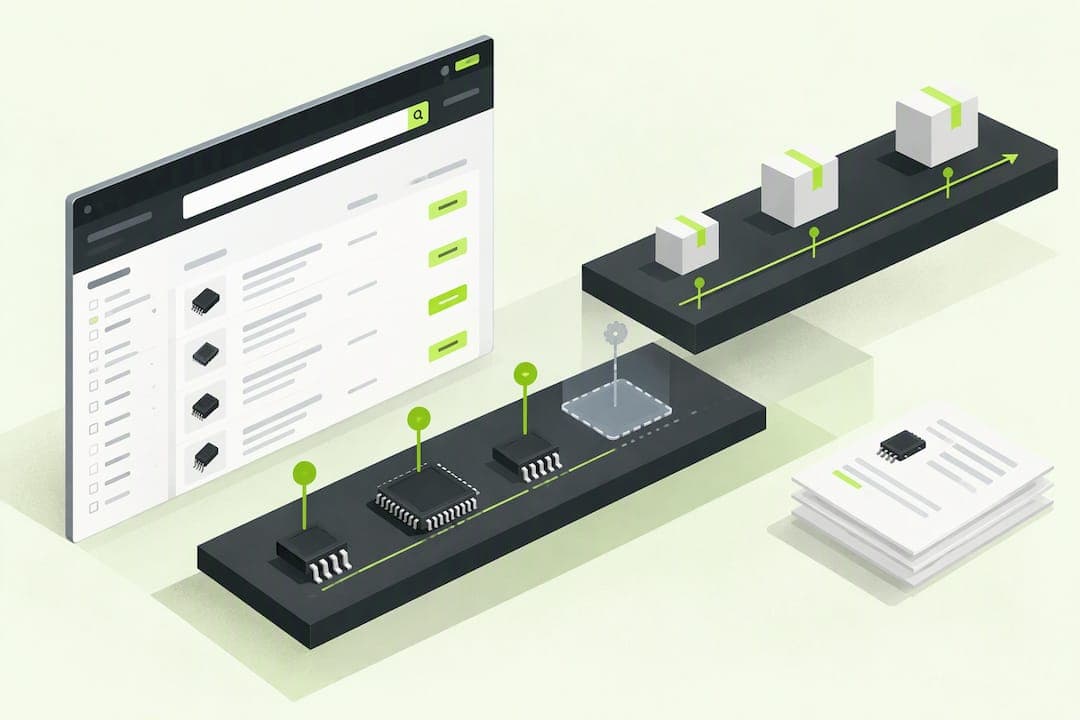
Design for availability means choosing components and PCB layout practices so a design has viable, sourceable replacements for the entire life of the product, not just at launch. The core approach is simple: prioritize parts with multiple qualified sources, add footprint flexibility where it fits, and pair every design decision with active BOM monitoring and vetted procurement.
TL;DR:
- Embedded and industrial products often need 7 to 10 years of support, while standard parts may leave production sooner; manufacturer lifetime estimates are not guarantees.
- Layered footprints can fit alternate package sizes on one board for passives and small analog devices; verify mask spacing, pin mapping, and thermal behavior before release.
- Buy through authorized distributors; if that is not possible, require traceability and inspection records, since no single counterfeit test catches every suspect component.
- Set BOM alerts for EOL notices, longer lead times, and price spikes; reprice every line at each design gate and before a production order.
Table of Contents
- Why availability matters: product lifecycles, EOL, and counterfeit risk
- Core design strategies that improve sourceability
- Procurement and sourcing practices that make design decisions effective
- How BOM and availability monitoring tools fit into the workflow
- Step-by-step checklist: implement design for availability on a project
- Balancing design trade-offs and procurement realities
- How a parts directory and BOM tool speed these decisions
- FAQ
- Sources
Why availability matters: product lifecycles, EOL, and counterfeit risk
Commercial component lifecycles rarely match product lifecycles. Many standard parts stay in production for a few years, while embedded, industrial, and automotive products often need 7 to 10 years of support, and sometimes longer. That gap is where redesigns, last-time buys, and schedule slips come from.
Manufacturer longevity guidance helps close that gap, but it comes with caveats. NXP's product longevity program publishes estimated power-on hours based on junction temperature, duty cycle, and performance mode, and it states plainly that these are statistical estimates, not guarantees. A part rated for a long operating life under mild conditions can age faster in a hot enclosure or a high duty cycle application.
Late discovery of an end-of-life notice is one of the costliest failure modes in hardware. JEITA materials on EOL management point out that catching "do not use for new designs" flags early, and registering them in an internal parts database, prevents the scramble that otherwise forces a late redesign or an expensive last-buy order.

Counterfeit risk compounds the problem once a part goes end-of-life and buyers look outside normal channels. IPC guidance on counterfeit components notes that detection methods such as decapsulation, x-ray, visual inspection, and functional testing each have limits, which means the real safeguard is a trustworthy test house with documented procedures, not any single test.
Three realities drive the rest of this article:
- Standard parts often cycle out of production faster than the products that use them.
- An EOL notice caught early costs a line change; one caught late costs a redesign.
- No single inspection method catches every counterfeit part, so sourcing discipline matters as much as testing.
Counterfeit components carry a multi-billion-dollar impact across the industry, according to IPC's counterfeit components resource, and that scale is exactly why procurement traceability belongs next to every design decision, not after it.
Core design strategies that improve sourceability
A handful of layout and part-selection habits determine whether a board can absorb a component shortage without a revision.
- Favor part families with second sources. When a device has a qualified second-source equivalent, prefer it over a single-source part, and treat qualification testing as part of the selection decision rather than an afterthought.
- Use layered footprints where board area allows. TI's application notes on dual footprints describe placing a smaller package footprint inside a larger one so either part can be mounted without a board revision. The technique works well for passives and small analog devices, less well where pin count or thermal pads make overlap impractical.
- Pick common package families over exotic ones. SOIC, TSSOP, and VSSOP footprints have far more cross-manufacturer substitutes than less common packages. A second-sourcing note from TI on small-package amplifiers shows how layering SOIC and TSSOP or VSSOP footprints on the same pad set extends substitute options for a single design.
- Budget layout margin for mask spacing. Reliable solder-mask fill between overlapping pads requires careful attention to spacing, per the same TI guidance, and that spacing requirement can force routing or trace-length compromises near decoupling capacitors.
- Validate substitutes before committing to the layout. Check footprint fit, pin mapping, and thermal behavior for the alternate part in your layout tool and thermal model before you release the board, not after a shortage forces the question.
Pro Tip: Place a test coupon of any layered footprint on an early prototype panel and have your assembler confirm placement accuracy for both package options before you lock the production footprint.
Procurement and sourcing practices that make design decisions effective
Good footprint choices only pay off if purchasing backs them with disciplined sourcing. Buying from unauthorized channels without traceability undoes the benefit of a well-designed board the moment a counterfeit part reaches the line.
- Buy from authorized or franchised distributors first, and when that is not possible, require documentation of traceability and inspection history before accepting a shipment, consistent with IPC's risk mitigation guidance.
- Vet independent test houses directly: ask what equipment they use, what tests they run, and whether you can audit the facility before relying on their sign-off.
- Register EOL-sensitive parts in an internal database and plan last-time buys, buffer stock, and phased transitions well before a part's final order date, as JEITA's EOL management guidance recommends.
- Track supplier change notifications, including shifts in fab or assembly site, since manufacturing-site changes can alter reliability and availability on long-lifecycle parts.
- Build qualification forms and purchase orders that require lead-time disclosure, traceability documentation, and change notification commitments from every new supplier.
How BOM and availability monitoring tools fit into the workflow
A bill of materials is only as useful as the alternates and stock data attached to it. A workable routine looks like this: match each line to parametric alternates, check stock and pricing across multiple distributors at the quantities you actually plan to buy, and flag any listing that comes from an older catalog snapshot rather than a live feed.
- Set alerts for EOL notices, allocation-driven lead-time surges, and price spikes on every part in the BOM.
- Reprice the full BOM at each design gate review and again right before placing a production order, since pricing and stock shift between those milestones.
- Check footprint fit and thermal impact for proposed substitutes early, so swapping a part does not force a late layout rework.
Pro Tip: Keep a ranked list of alternates directly in the BOM, with a short supplier note on each one, so purchasing can act the moment a primary part goes on allocation.
Step-by-step checklist: implement design for availability on a project
- Set availability targets at the start of component selection: minimum lifetime, authorized-distributor requirement, and second-source preference.
- Apply layered footprints selectively, following mask-spacing guidance, and confirm the layout in your PCB tool before release.
- Populate the BOM with parametric alternates and turn on monitoring for EOL notices and allocation signals.
- Qualify suppliers, request traceability documentation, and plan last-buy windows and buffer stock where lifetime risk is high.
- Schedule a BOM repricing pass at every milestone gate and again immediately before a production buy.
Balancing design trade-offs and procurement realities
The projects that avoid late-stage part crises are the ones where design and purchasing agree on lifetime targets and sourcing rules before the first schematic is final, not after a part goes end-of-life. A slightly more expensive part with a real second source is often the cheaper choice over a product's life, even when it loses on a line-item BOM comparison today.
— Matthew
How a parts directory and BOM tool speed these decisions
Checking stock, pricing, and alternates across dozens of distributors by hand is slow enough that it rarely happens as often as it should. We built our catalog and BOM Tool so you can run that check in minutes instead of an afternoon.

- Search more than 1,000,000 components across dozens of distributors, sorted into 28 categories and 189 subcategories, with price and stock compared at 1, 10, 100, and 1,000 pieces.
- Upload a spreadsheet or a KiCad, Altium, or Eagle export to our BOM Tool and get every line matched to real parts and priced at your production quantity.
- Open a KiCad project right in your browser with Circuit Designer to check footprints, the 3D view, and a priced BOM before you commit to a layout change.
Try the BOM Tool on your current project, or browse Circuitcenter to see how your parts price out this week.
FAQ
What does "design for availability" mean in hardware engineering?
It means choosing components and PCB layout practices that keep a design sourceable over its entire production life, not just at the prototype stage. The core tactics are preferring second-sourced parts, using layered footprints where practical, and monitoring the BOM for end-of-life and allocation signals.
How long should I expect a component to stay in production?
It depends heavily on the part category and manufacturer, so there is no single number that applies everywhere. Embedded and industrial products commonly need 7 to 10 years of component support, which is often longer than a standard commercial part's typical production run.
What is a layered or dual footprint and when should I use it?
A layered footprint places a smaller package's pads inside a larger package's footprint so either part can be mounted on the same board without a revision, as described in TI's application guidance. Use it for passives and small analog devices where board area allows the mask spacing the technique requires.
How do I reduce the risk of receiving counterfeit components?
Buy from authorized or franchised distributors whenever possible, and when you cannot, require documented traceability and inspection history from the seller. IPC's guidance on counterfeit risk notes that no single inspection method catches every counterfeit part, so a vetted test house with transparent procedures matters more than any one test.
Does Circuit Center help with sourcing alternates for an at-risk BOM?
Our BOM Tool matches each line in your file to real parts and prices your build at your planned quantity, with a recommended supplier per line, so you can compare alternates before a shortage forces the question. The catalog search covers a large number of components across many distributors with live stock and pricing.