
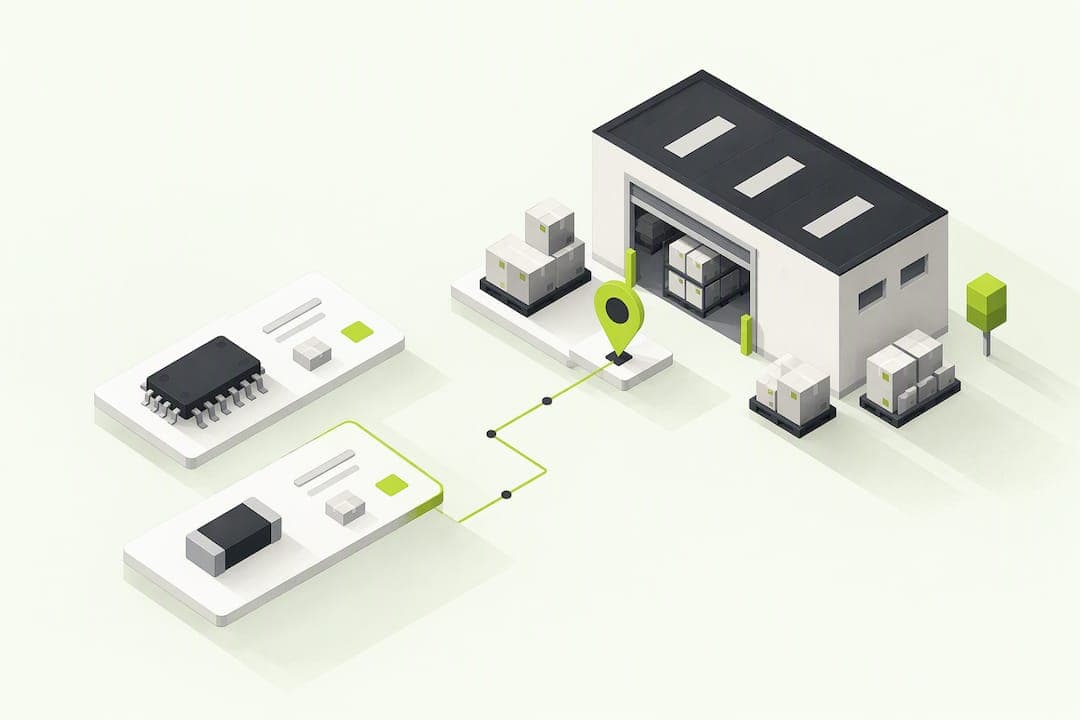
The fastest path to a local electronics supplier starts with the manufacturer's own authorized distributor locator, followed by a part-number search in a tool that shows live stock across sellers. For same-day prototyping needs, local stocking distributors and retail electronics shops with pickup counters fill the gap, while production orders should route through the authorized channel the manufacturer lists for your part.
TL;DR:
- Record the exact manufacturer part number, package code, and revision, then call the branch to verify physical quantity; online inventory may be stale.
- For production parts, confirm the seller appears on the manufacturer’s authorized locator and request a certificate of conformance plus lot traceability before payment.
- Use local pickup to rescue a stalled prototype, but place a parallel order through an authorized distributor when the part may enter production.
- A BOM matching tool compares live stock, supplier recommendations, and prices at 1, 10, 100, and 1,000 units; Circuit Center reads files in your browser.
- Before choosing a local supplier, ask about minimum order quantities, actual shelf counts, restock frequency, and whether quoted lead times match past deliveries.
Table of Contents
- How do you find local or nearby suppliers and confirm stock?
- How do you verify authenticity and decide which suppliers to trust?
- When is same-day pickup the right call?
- How do BOM tools speed up finding nearby stock?
- How do you evaluate a local electronics supplier before you commit?
- What's the right way to negotiate price and terms locally?
- How does local supplier logistics and delivery actually work?
- How can online communities help you find reputable local suppliers?
- Balancing speed and traceability in real projects
- Circuit Center: a single workspace to find parts, price a BOM, and locate pickup points
- FAQ
- Sources
How do you find local or nearby suppliers and confirm stock?
Finding a nearby supplier with the part actually on the shelf takes a few deliberate steps rather than a general search engine query.
- Nail down the exact part: write down the manufacturer part number, package type and revision before you search anything. A "10k resistor" search wastes time; "10k 0603" or a specific MPN does not.
- Check the manufacturer's locator first: most component makers publish a "where to buy" page or an authorized distributors list, as Arduino does for its boards and modules. These pages point you to the sellers the manufacturer has actually vetted.
- Run the part number through a multi-distributor search: paste the MPN into a search tool that pulls live stock from several distributors at once, then filter for ship-from location or pickup availability.
- Use maps and business listings for the physical leg: distributor locator pages, like the Keystone Electronics distributor map, list regional stocking partners with phone numbers. Call ahead to confirm the part is actually on the shelf, not just listed.
- Document what you find: note the quoted lead time, quantity on hand, and whether the supplier can provide a certificate of conformance.
A short checklist keeps the search efficient once you're on the phone or at the counter:
- Confirm the exact MPN and package code match what's in stock, not a close substitute.
- Ask about current quantity on hand.
- Request a lead time if the part has to come from a backroom or sister location.
- Ask whether lot traceability documents are available for that batch.
Skipping steps 1 and 2 is the most common reason engineers waste time driving between shops that never had the part in the first place.
How do you verify authenticity and decide which suppliers to trust?
Verification matters more for production orders than for a one-off prototype resistor, but the habit of checking is worth building early.
For parts going into a product that will ship, prioritize suppliers who appear on the manufacturer's own authorized distributor locator. JEDEC JESD243 documents counterfeit parts control plans and requires manufacturers to maintain and publish those authorized distributor lists, which is exactly why checking that list first lowers your risk. SAE AS6496 covers the same ground from the distribution side, defining what counts as authorized or franchised distribution for counterfeit avoidance purposes. For a deeper framework, SAE AS5553E outlines a full counterfeit parts control plan, including risk-based mitigation and documentation of which distributors are authorized for which parts.
Practical checks follow from those standards:
- For production-critical parts, ask for a certificate of conformance and lot traceability before you pay.
- Record the distributor's contact details and the authorized-locator listing you found them on.
- For prototypes, local stocking distributors are fine, but log where the part came from and inspect it on arrival.
- Keep photos of packaging and lot numbers for anything that might end up in a shipped product.
A documented chain of custody, built from an invoice, packaging photos and a lot number, is the minimal audit trail that lets a prototype purchase convert cleanly into a production record if the design moves forward. This habit costs a few minutes per order and saves hours if a part is ever questioned during a design review or a field failure investigation.
When is same-day pickup the right call?
Same-day pickup earns its place when a prototype is stalled on one missing part and waiting for shipping would cost more time than it's worth.
Start by searching for a "pickup" or "ship-from" field on the distributor's part page, then call the location to confirm the part is physically there before you drive over. A listing showing stock doesn't always mean that specific branch has it in hand.
- Bring the exact part number and package code, plus a list of acceptable substitutes in case the shelf is short.
- Treat anything bought at a local shop as provisional for production use since many walk-in counters can't provide full traceability paperwork on the spot.
- Photograph the packaging and note any lot number printed on it, even for a quick prototype buy.
- If the part is production-critical, use the local pickup only to keep the prototype moving, then place a parallel order through an authorized distributor to backfill the production-grade supply.
Pro Tip: Call before you drive. A five-minute phone call confirming exact stock on hand saves a wasted trip when the online listing is a day or two stale.
How do BOM tools speed up finding nearby stock?
Matching a full bill of materials against local stock by hand means opening a dozen distributor tabs and repeating the same search for every line item. A BOM-matching workflow collapses that into one pass: export the design from KiCad, Altium or Eagle, upload or paste the file, and the tool matches each line to real parts and checks live distributor feeds.
The output is what actually matters for sourcing decisions:
- Live prices at 1, 10, 100 and 1,000 piece quantities, so you can see how the per-unit cost shifts before you commit to a volume.
- A recommended supplier for each line, chosen from whichever distributor has stock at your quantity.
- A pickup map layer where it's available, surfacing nearby counters for parts you need today rather than next week.
With Circuit Center's BOM Tool, the uploaded file is read in your browser and only the part numbers are looked up, so the design itself never has to leave your machine to get priced. That matters for teams who don't want a schematic or BOM sitting on a third-party server longer than necessary.
Pro Tip: Re-run a saved BOM through the tool whenever a part goes out of stock. It's faster than manually rechecking a dozen lines one at a time.
Use this workflow for prototyping re-pricing, for checking whether a substitute part fits the same footprint and specs, and for the quick-turn question of whether anything on your list is sitting on a shelf nearby today.
How do you evaluate a local electronics supplier before you commit?
Not every supplier that answers the phone is worth building a relationship with. A few criteria separate the reliable ones from the ones that waste your time.
Stock reliability matters more than price for prototyping work: a supplier who consistently has common passives, connectors and small ICs on hand saves far more time than one who occasionally beats the price by a few cents. Ask how often they restock a given line and whether their online inventory count reflects what's actually on the shelf.
Minimum order quantities decide whether a local supplier is even usable for a one-off prototype. Some local distributors still enforce reel or tape-and-reel minimums left over from production-focused business, which rules them out for a two-board prototype run. Ask directly before you place an order rather than finding out at checkout.
Lead time quoted versus lead time delivered is the gap that actually costs schedule. A supplier who quotes two days but regularly delivers in five is worse for planning purposes than one who quotes five and hits it. Keep a running note on which local suppliers deliver on their stated timelines.
Finally, weigh how a supplier handles substitutions. A good local counter will tell you plainly when they don't have the exact part but do have a pin-compatible alternative, rather than letting you leave empty-handed when a workable substitute was sitting in the next bin.

What's the right way to negotiate price and terms locally?
Local suppliers have more room to negotiate than their list prices suggest, especially once you're buying more than a handful of parts at a time.
Volume is the simplest lever. Even a modest prototype run, 50 or 100 units of a connector or passive, often qualifies for a price break that isn't posted anywhere online. Ask directly whether there's a quantity price break near your target volume rather than assuming the listed single-unit price is final.
Payment terms are worth raising for any supplier you expect to order from repeatedly. Net 30 terms, waived minimum order fees, or a standing account are common asks for a buyer who places orders every month rather than once.
Bundling helps too. If you're picking up several line items from the same counter, ask for a combined quote rather than paying list price item by item. Many local distributors will shave a percentage off a multi-line pickup order that they wouldn't offer on a single part.
Be upfront about what you're buying for. A supplier who knows you're prototyping now and may place a production order later has more reason to work with you on terms than one who thinks you're a one-time walk-in. That context alone sometimes unlocks better pricing without any further negotiation.
How does local supplier logistics and delivery actually work?
Local sourcing isn't just about driving to a counter. Most stocking distributors offer a mix of delivery options worth understanding before you default to pickup every time.
Same-day delivery exists at many local distributors for orders placed before a cutoff time, usually mid-morning to early afternoon depending on the branch. It costs more than standard shipping but can beat a drive across town once you factor in your own time.
Will-call pickup, where an order is set aside at a counter for you to collect, is often the fastest option for parts the branch already stocks. Confirm the order is actually pulled and ready before you leave, since "available" in a system doesn't always mean "sitting at the counter."

Route and zone restrictions matter for same-day delivery specifically. A distributor's same-day radius is usually tighter than their general delivery area, so a part showing as "in stock nearby" might still fall outside the window for delivery that day even if pickup is fine.
For anything time-sensitive, call and ask directly: can this ship same-day, is will-call pickup ready now, and what's the actual cutoff for either option today. The answer changes by branch and by time of day, so checking live beats trusting a static delivery estimate on a website.
How can online communities help you find reputable local suppliers?
Forums and community groups are an underused shortcut to finding suppliers that don't show up prominently in a general search.
Local maker spaces and electronics meetup groups often maintain informal lists of which nearby shops reliably stock prototyping parts, since members run into the same sourcing problems repeatedly. Asking in a regional electronics or robotics forum thread usually surfaces a supplier that longtime local builders already trust, often faster than searching alone would.
Component-specific forums, the kind organized around a particular microcontroller family or test equipment category, tend to have threads where members name the distributor or local shop that actually had a hard-to-find part in stock. These threads age well since posters usually follow up if a supplier's reliability changes over time.
Treat forum recommendations as a starting point rather than a verification step. A community thread can point you toward a shop worth calling, but the authenticity checks against a manufacturer's authorized distributor list still apply once you're deciding whether that supplier is appropriate for a production order rather than a one-off prototype buy.
Balancing speed and traceability in real projects
My default workflow on any new design is the same regardless of part complexity: check the manufacturer's authorized locator first, run the part number through a BOM match to see live stock, fall back to local pickup only if the schedule is genuinely tight, document where every part came from, and confirm the production channel before the design freezes.
The habit that actually saves time isn't skipping steps, it's not repeating them manually across a dozen browser tabs. A tool that compares live stock and shows pickup options in one pass removes the busywork, which is exactly where engineers lose afternoons.
Try running your next BOM through a tool-based workflow before defaulting to a string of phone calls. Traceability doesn't have to cost you speed if you document as you go.
— Matthew
Circuit Center: a single workspace to find parts, price a BOM, and locate pickup points
We built Circuit Center so you don't have to run this checklist across a dozen browser tabs. Search parts across distributors in an integrated directory, price a full build with a BOM tool, open a KiCad project directly in a browser-based designer, and check Parts for Pickup to see which nearby counters have your part on the shelf right now.

Paste a part number or upload your BOM at Circuitcenter and see live pricing, stock, and pickup options before you make a single phone call.
FAQ
What's the fastest way to find a local electronics supplier?
Start with the manufacturer's authorized distributor locator or "where to buy" page for your exact part, then run the part number through a multi-distributor search tool that shows stock and pickup location. This combination gets you a traceable source and a same-day option without manually checking individual distributor sites.
How do I know if a local supplier is authorized or trustworthy?
Check whether the supplier appears on the manufacturer's own authorized distributor locator, since standards like JEDEC JESD243 require manufacturers to maintain and publish those lists as part of counterfeit parts control. For production purchases, also ask for a certificate of conformance and lot traceability documentation.
Can I use a local shop for parts that will go into a production build?
Local shops work well for prototyping, but production-relevant parts should be backfilled through an authorized distributor once the design stabilizes. Keep a record of where the prototype part came from, including an invoice and lot number, so the sourcing history stays intact if the design moves to production.
What should I bring when picking up parts same-day?
Bring the exact manufacturer part number, package code, and a short list of acceptable substitutes in case the shelf quantity is short. It also helps to photograph the packaging and note any lot number, especially if the part might later be used in a production run.
How does Circuit Center help with finding local parts?
Circuit Center's BOM Tool matches your part list against live distributor feeds and shows pricing at multiple quantities along with a recommended supplier for each line, and the Parts for Pickup map surfaces nearby counters with stock. The file itself is read in your browser, so only the part numbers are looked up during the match.
Sources
- JEDEC JESD243 (counterfeit EEE parts control)
- SAE AS6496 (authorized/franchised distribution)
- Arduino authorized distributors list (example)
- Keystone Electronics distributor locator (example)