
You avoid obsolete parts by making availability a design input rather than a purchasing afterthought. Check each part's lifecycle and sourcing before it enters the schematic. Prefer parts with real alternates. Re-screen the whole bill of materials (BOM) on a schedule. Keep a written plan for the day a notice arrives. None of this removes obsolescence, because component life cycles are usually shorter than product life cycles. It moves the surprise from a production line that has stopped to a review meeting you scheduled.
TL;DR
- Obsolescence is a mismatch problem: parts live shorter lives than the products built on them, so plan for it at the start of a design.
- Screen every line of the BOM for lifecycle status, number of sources and stock depth before layout, not after.
- Choose parts that have a pin-compatible or functional alternate, and record that alternate in the BOM.
- Re-check the BOM on a fixed schedule, and decide in advance how you will respond to a notice: substitute, last-time buy or redesign.
- Treat aftermarket and broker stock as a counterfeit risk and qualify it accordingly.
Table of Contents
- What "obsolete" means for a component
- Why parts disappear faster than products
- What it costs when you get it wrong
- Screen parts before they reach the schematic
- Build alternates into the design
- A worked example: screening a small BOM
- Where the BOM tool fits
- Re-screen on a schedule
- Our perspective
- When a notice arrives anyway
- Special cases worth planning for
- A checklist you can reuse
- FAQ
- Sources
What "obsolete" means for a component
A component becomes obsolete when it is no longer manufactured. According to the University of Maryland's Electronic Systems Center for Manufacturing and Logistics, that happens when demand falls too low to justify production, or when the materials or technologies needed to make it are no longer available. Two situations get lumped together, and they call for different responses:
- Discontinuance is a manufacturer ending production of a specific part. The same function usually remains available from a successor or competitor.
- Obsolescence is the broader loss of the underlying technology or supply, so there may be nothing equivalent to move to. The Maryland research on electronic part life cycles draws this distinction.
The industry term for the consequence is DMSMS, short for diminishing manufacturing sources and material shortages. It is the loss or impending loss of original manufacturers or suppliers, and it can force product changes and make sustainment expensive.
There is one more case that catches small teams. Inventory can become obsolete without any supplier doing anything: when your own specification changes, parts you bought stop being needed. The Maryland work on designing for obsolescence risk management notes this, and notes that aftermarket availability may remain but brings risks such as counterfeit parts.
Why parts disappear faster than products
The core problem is a timing gap. Rapid technology change, such as higher speeds, smaller feature sizes, lower supply voltages and new packaging, shortens component life cycles, often well below the life of the products that use them. McKinsey gives a stark example from long-life equipment: complex systems such as aerospace platforms can have 30-year life cycles while their semiconductors may last under five years.
Most readers of this page do not build aircraft. But the same logic applies to an industrial controller you plan to sell for eight years, a medical accessory, or a test fixture your own factory depends on. The shorter your product's life, the lower your exposure, yet even a three-year product can lose a part in year two.
Sourcing pressure adds to this. The same McKinsey analysis points out that components also get harder to find when suppliers struggle to obtain raw materials or stop making them, and that semiconductor scarcity, higher raw-material costs and interconnected supply chains tighten the constraints. A part can be "active" on a datasheet and still be unavailable at a sensible price for months.

What it costs when you get it wrong
The largest published figures come from defense. McKinsey estimated that obsolescence-related nonrecurring engineering costs for 18 military aircraft in production reached $50 billion to $70 billion in fiscal year 2021. Your numbers will be smaller, but the shape is the same: an unplanned redesign means engineering time, new layout, requalification, new test fixtures and a gap in shipments.
For a startup, the cost that hurts most is usually schedule. A forced respin of a four-layer board can be done in weeks. Qualification by a customer, a certification lab or a safety standard can take far longer. That is why the cheapest moment to deal with obsolescence is before the first board is ordered.
Screen parts before they reach the schematic
The single most effective habit is to treat three questions as selection criteria, on the same footing as voltage rating and package.
1. Where is this part in its life?
Look at the manufacturer's own lifecycle designation and any product change or end-of-life notices. Be wary of parts described as "not recommended for new designs", and of anything at the tail of a technology: older process nodes, legacy interfaces, and packages the industry is moving away from. Our guide on spotting component lifecycle risk before it hits your BOM walks through the signals worth checking.
2. How many sources exist?
A part with one manufacturer and one distributor is a single point of failure, even if it is healthy today. Prefer standard-footprint parts that several vendors make, and be cautious with single-source specialty devices. If you must use one, make the decision deliberately and note it. The reasoning behind this is covered in design for availability, where we argue that second sources alone are not enough.
3. How deep is the stock, and how fresh is the price?
Stock on one distributor's page tells you little. What matters is whether several sellers hold the part, in what quantity, and whether the price you see comes from a live feed. A part that shows stock at one seller only, or only through old listings, is a warning sign even when its lifecycle status looks fine.
Build alternates into the design
Choosing a part with a known alternate is a cheap form of insurance. For passives, the alternate is usually another manufacturer's equivalent in the same package and rating. For ICs, it may be a pin-compatible device, or a different part that needs a small firmware or layout change.
Two practices make this real rather than theoretical:
- Record alternates in the BOM. A column for approved alternates means the buyer can act without calling an engineer. When you do need to approve a substitute, run the checks in cross referencing part numbers: footprint, electrical limits, temperature range, and the behavior that datasheets do not summarize.
- Design the footprint for flexibility. Where it costs little, lay out pads that accept more than one package variant, or leave room for the larger of two likely alternates.
Substitution is not free. The Maryland guidance says to evaluate whether a substitute or alternative part is suitable, including whether it needs requalification. For products with regulatory or customer approvals, a "drop-in" part can still trigger a new round of testing.
A worked example: screening a small BOM
Imagine a 60-line BOM for a sensor node. Here is how a review might sort the lines.
| BOM line | What you find | Action |
|---|---|---|
| 10 kΩ 0603 resistors | Many manufacturers, deep stock everywhere | Approve, list two alternates |
| Standard LDO regulator | Several pin-compatible parts from different makers | Approve, record the alternate |
| Specialty sensor IC | One manufacturer, two distributors, one with old pricing | Flag: ask about longevity, plan a buffer |
| Legacy interface transceiver | Lifecycle marked not recommended for new designs | Replace now, before layout |
| Custom connector | Single source, long lead time | Decide early whether to carry safety stock |
The review is quick because most lines are boring. The value comes from isolating the five or six lines that are not, and doing something about them while a change is still cheap. In a design of this size those lines usually decide whether you ship on time.
Where the BOM tool fits

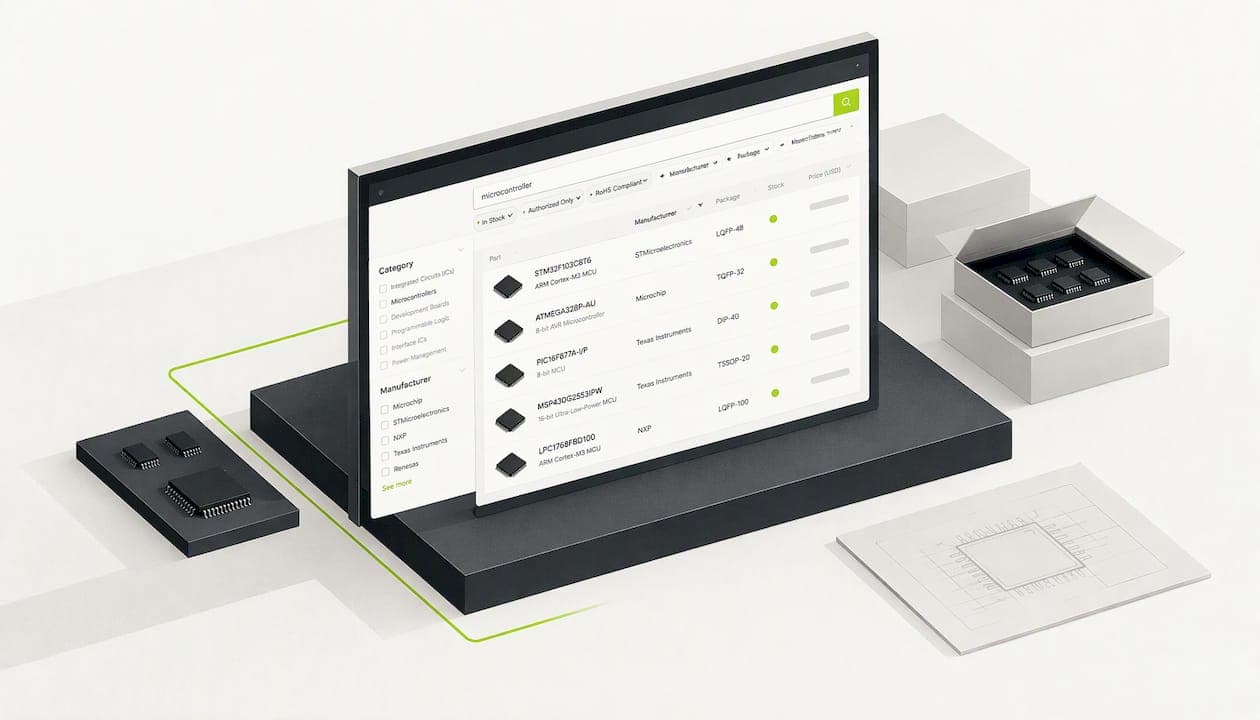
Doing this by hand across dozens of distributor sites is slow, and it is the reason many teams skip it. Circuit Center is a free electronic components search and design workspace built for exactly this check. Search compares price and stock across sellers at 1, 10, 100 and 1,000 pieces, and says plainly whether a price comes from a live distributor feed or an older listing. That last point matters for obsolescence, because stale listings are one of the first places a dying part hides.
The BOM pricing tool takes a spreadsheet or a KiCad, Altium or Eagle export, matches every line to real parts, and prices the build at your quantity with a recommended supplier per line. Lines that fail to match, show thin stock or rely on old listings stand out right away. The file is read in your browser and only part numbers are looked up. If you work in KiCad, the Circuit Designer opens your project in the browser and prices a BOM from the schematic, so you can check availability while you are still choosing parts.

When you are ready, open the Circuit Center workspace and load your BOM. A share link sends the priced list to a colleague or buyer so the review does not live in one person's head.
Re-screen on a schedule
A BOM that was clean at design freeze will not stay clean. Obsolescence management is a process, not a one-time check. The international standard IEC 62402 frames it that way: establish a policy, organization and plan, develop design strategies, select and implement resolutions, then measure and improve, and plan from the earliest life-cycle phases.
For a small team, a workable rhythm looks like this:
- At design freeze: a full screen of every line for lifecycle, sources and stock.
- Before each production order: a quick re-check of the lines flagged last time, plus any lines whose stock or price moved.
- Quarterly or twice a year: a full re-screen, especially for products with a long sales life.
- On any notice: an immediate review of which products use the part, and how many months of supply you hold.
The same logic applies to your own stock. Our write-up on inventory risk analysis covers how to judge how exposed your shelves and open orders are.
Our perspective
We build a search tool and a BOM tool, so we see the same pattern in the part numbers people look up. Teams rarely get hurt by a part they knew was risky. They get hurt by a part nobody looked at, because it was a ten-cent line item on page three of the BOM.
Our view is that availability should be as visible as price. That is why every result in Circuit Center compares sellers side by side and says whether a price is live or older. A part with one seller and an old listing deserves the same scrutiny as a part with a tight tolerance, and in a small team that scrutiny only happens if it is cheap to do. We would rather an engineer spend ten minutes screening a BOM before layout than ten days fixing it after the boards are built.
We also think "just buy extra" is overused. Extra stock helps with a short shortage and can be a good answer for one or two critical parts. Applied to a whole BOM, it ties up cash and risks the other kind of obsolescence, where the design changes and the shelf of parts no longer fits.
— Matthew
When a notice arrives anyway
Even careful teams get end-of-life notices. The reactive playbook is short. The Maryland guidance lists the main resolutions: substitute or alternative parts, a lifetime buy, or an aftermarket source. Which to pick depends on timing and how much the part matters.
Substitute
If a suitable alternate exists, this is usually the cleanest outcome. Verify it against the real requirements of your design, not only the headline specs, and decide whether the change needs requalification.
Last-time buy
When no substitute works, or while you prepare a redesign, buy enough to cover demand through the support life. The Maryland research advises forecasting that demand and accounting for uncertainty, inventory holding costs, and the penalties of both shortage and excess. In practice that means writing down a sales forecast, a range rather than a single number, and deciding which error is worse for you: running out or holding surplus.
Aftermarket and broker stock
Stock from outside the authorized channel can bridge a gap, but it carries counterfeit risk that some systems cannot accept, as the Maryland work points out. If you go this route, set inspection and testing requirements before buying, not after the parts arrive. Our obsolete parts sourcing guide covers the practical steps.
Redesign
Sometimes the honest answer is to move to a newer part. The earlier you decide, the more of the schedule you control. A last-time buy is often best seen as the time that pays for the redesign, not a replacement for it.
Special cases worth planning for
Automotive and other qualified parts. Qualification labels narrow the list of acceptable alternates, so a substitute may not exist at all. See what the label means in automotive grade components before you assume a commercial part can replace one.
Prototype and low-volume builds. Small buyers have less leverage than large ones, so a part that is available in tens may disappear sooner from your point of view than from the manufacturer's. The broader picture is in our electronic component sourcing guide for hardware teams.
A part needed today. If a missing component is blocking a build, the right move may be local. Parts for pickup maps nearby suppliers with a pickup counter, so a gap does not cost you a week of shipping. It is a stopgap for a prototype, not a substitute for a lifecycle plan.
Cost tracking. Availability changes price, and price changes the case for redesign. BOM pricing costs are worth tracking from the first spreadsheet onward.
A checklist you can reuse
- Does the part have an active lifecycle status, and no recent end-of-life or change notices?
- Is it made by more than one manufacturer, or does it have a pin-compatible alternate?
- Do several distributors hold stock, and is the price from a live feed?
- Is the technology mature but not near the end of its run?
- Is the alternate recorded in the BOM, with notes on what would need requalification?
- Do you know how many units you would need in a last-time buy, and who approves it?
- When is the next scheduled re-screen?
FAQ
What is the fastest way to avoid obsolete parts in a new design?
Screen the BOM for lifecycle status, number of sources and stock depth before you lay out the board. Replace any line that fails while a change is still cheap. Pricing the BOM in a tool that compares sellers will expose thin or stale lines quickly.
How often should I check my BOM for obsolescence?
Check at design freeze, before each production order, and on a regular schedule such as every quarter or six months for long-lived products. Check immediately when you receive a discontinuance notice. IEC 62402 recommends planning obsolescence management from the earliest life-cycle phases.
Is a last-time buy a good idea?
It can be, when no suitable substitute exists or while a redesign is underway. Forecast demand across the support life and weigh the cost of holding stock against the cost of running short. Buy only from sources you can trust, because aftermarket stock carries counterfeit risk.
What is the difference between a discontinued and an obsolete part?
Discontinuance means a manufacturer has stopped producing a specific part. Obsolescence is broader: the underlying technology or supply is gone, so an equivalent may not exist. A discontinued part often has a successor, and an obsolete technology often does not.
Sources
- ESCML Electronic Part Obsolescence, University of Maryland
- Electronic Part Life Cycle Concepts and Obsolescence Forecasting
- Designing for Technology Obsolescence Management
- Design for obsolescence risk management
- How industrial and aerospace and defense OEMs can win the obsolescence challenge, McKinsey
- BS EN IEC 62402:2019 Obsolescence management, BSI Knowledge