
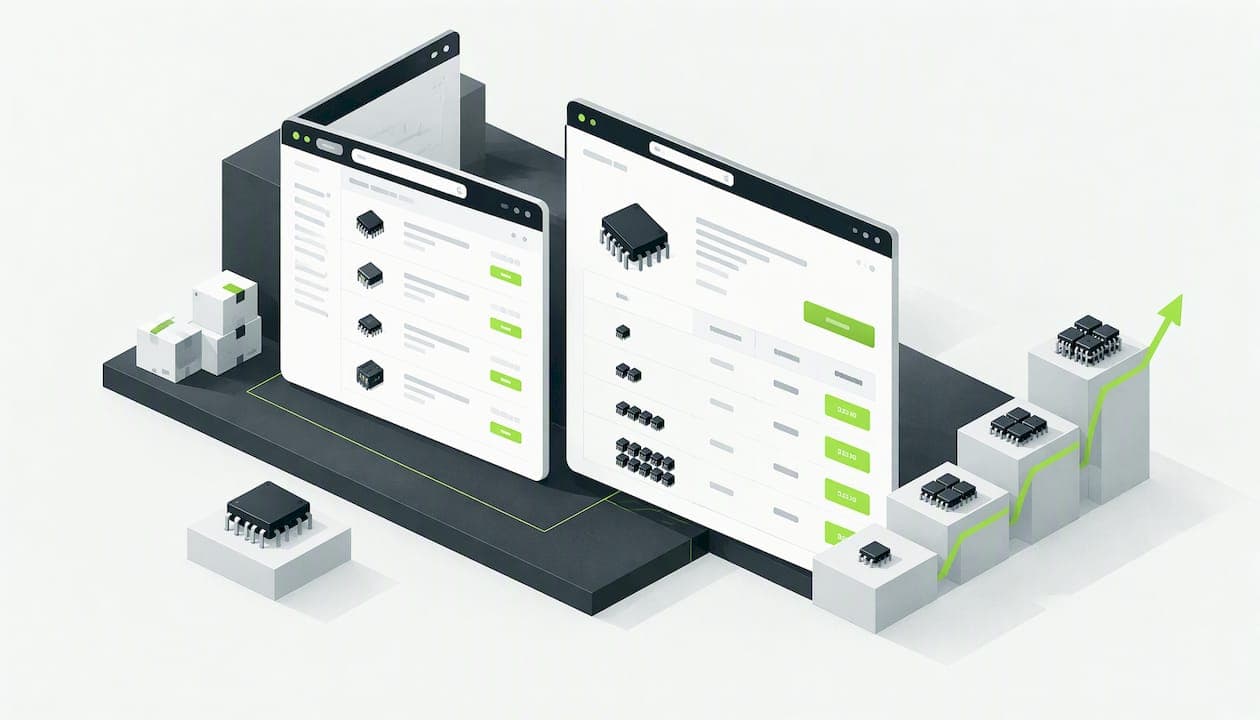
A price break is the order quantity at which a distributor's unit price steps down. On electronic components, the ladder usually starts at 1 piece and steps down at 10, 100 and 1,000. The useful skill is not spotting the lower price. It is knowing whether the lower price still wins once you count the parts you did not need, the reel you may be pushed into and the cost of holding stock.
This guide shows how to read a price ladder, how to calculate the break-even quantity, and where price breaks mislead prototype and low-volume buyers.
TL;DR
- A price break is a lower unit price that starts at a set quantity. Quantity break, quantity price break and volume pricing tier mean the same thing.
- Buying up to the next break can cost less in total than buying the exact quantity. The break-even point is the next-tier total divided by your current unit price.
- Unit price is only part of the real cost. Carrying cost, logistics, qualification and risk add up to a large share of what a part really costs, so a price break is one variable among several.
- Compare the same quantity across sellers, and check whether each price comes from a live feed or an old listing.
- Price the whole BOM at your build quantity, not line by line at quantity 1.
Table of Contents
- What a price break looks like on a component
- Cut tape, full reel and other packaging breaks
- How to find the true break-even quantity
- Why the lowest unit price is not the lowest cost
- Price breaks at 1 to 1,000 pieces: where small teams win and lose
- A six-step routine for reading price breaks on a BOM
- Our perspective: price the build, not the part
- Price your whole BOM at your quantity
- When to buy up, and when to stay put
- Keep the result: a preferred supplier list
- FAQ
- Sources
What a price break looks like on a component
Open any passive or IC listing and you will see a ladder like this one. The numbers are illustrative, not a quote from any seller:
| Quantity | Unit price | Extended price |
|---|---|---|
| 1 | $0.100 | $0.10 |
| 10 | $0.050 | $0.50 |
| 100 | $0.020 | $2.00 |
| 1,000 | $0.008 | $8.00 |
Three things to notice.
First, the unit price falls fast at the start of the ladder and slowly at the end. Moving from 1 to 10 pieces can halve the price per part. Moving from 100 to 1,000 saves far less in absolute dollars, even if the percentage looks large.

Second, the extended price is what you actually pay. A break only matters when the extended price at the higher tier beats the extended price at your real quantity.
Third, the ladder usually applies to the whole order line, not just the pieces above the break. Order 100 and all 100 pieces cost the 100-piece price. Always confirm this on the seller's page, because a few sellers and programs work differently.
Cut tape, full reel and other packaging breaks
For surface-mount parts, the packaging changes the ladder. Small parts such as resistors and capacitors typically come on tape. A distributor will cut tape to the exact count you ask for, which costs more handling and so costs more per part. The full reel price applies when you buy the whole reel, which for small SMD parts is often 1,000 to 3,000 pieces, according to engineers discussing it in a hobbyist forum.
This matters for your math in two ways:
- The top rung of a ladder is often the full-reel price, and it may carry a minimum order equal to the reel quantity. Check the minimum before you plan around that price.
- Cut tape and reel can be separate line items for the same part number. A part may show a different ladder in each packaging. Compare like with like.
Tubes, trays and bulk bags follow the same logic: a standard pack quantity, with a premium when you break the pack.
How to find the true break-even quantity
Here is the calculation to run whenever your needed quantity sits just below a break.
Take an IC with this illustrative ladder:
- 1 to 9 pieces: $4.80
- 10 to 99 pieces: $4.20
- 100 or more: $3.60
You need 80 pieces.
- Buy exactly 80 at $4.20: $336.00
- Buy 100 at $3.60: $360.00
Buying exactly 80 wins. The break-even quantity is the higher-tier total divided by the current-tier price: $360.00 ÷ $4.20 = 85.7. So from 86 pieces needed upward, buying 100 costs less than buying your exact count.
Now you need 90:
- Exactly 90 at $4.20: $378.00
- 100 at $3.60: $360.00
You save $18.00 and end up with 10 spares. For a part with lifecycle risk or one that you will use again next quarter, those spares are close to free. For a part that you will never use again, they are a sunk cost.
The formula in one line: break-even quantity = (break quantity × break price) ÷ current unit price. Anything at or above it, buy the higher tier.
Put a price on the surplus
Extra stock is not free. Procurement guidance commonly puts inventory carrying costs at roughly 12 to 25 percent of inventory value per year when you account for capital, storage, handling and obsolescence. On a $360 order held for six months, even the high end of that range is modest next to an $18 saving, so buying over wins. On a $20,000 order held a year, the same percentage is real money and the decision flips more often.
For a prototype run the carrying cost is rarely the issue. The real questions are simpler: will you use the spares, and could the part change or go end of life before you do?
Why the lowest unit price is not the lowest cost
A price break optimizes one number. One 2026 procurement analysis estimates that component unit price is only about 65 to 72 percent of the true total cost of ownership for a standard industrial BOM. The rest comes from inventory carrying, single-source risk premiums, qualification effort, logistics, compliance and the cost of failures. Treat those percentages as one analyst's estimate, not a law. Your own mix will differ, and a five-board prototype run looks nothing like a production line.
The practical lesson holds either way: a deep discount on a part that sits in a drawer, or that forces a risky single-source decision, is not a saving.
Three traps show up repeatedly.
Tariffs and duties. Duty and tariff treatment can add to the delivered price, and it varies by origin, destination and part classification. Check the landed cost for your country before you compare two sellers' ladders.
Special pricing programs. Some distributors offer special pricing authorizations that lower the unit price in exchange for rebate handling. Industry commentary warns that the administrative and financing burden can raise the true cost if you do not model it. For prototype quantities this rarely applies, but it explains why quoted prices at volume can differ from what a program actually costs.
Unauthorized stock. During shortages, parts from brokers can look cheap or, more often, expensive. Authorized and open-market inventory carry different risk, and the broker route deserves a higher risk premium in any cost model. If you must go that way, add counterfeit screening to the plan.

Price breaks at 1 to 1,000 pieces: where small teams win and lose
Most price-break advice is written for buyers ordering tens of thousands of parts. If you are building prototypes and pilot runs, your world is the first four rungs of the ladder.
That has consequences:
- The 1 to 10 step is the biggest. If you are building several boards, order for all of them at once. Ordering one board's worth of parts five times pays the quantity-1 price five times.
- Shipping often outweighs a break. A $2 saving from a lower tier disappears under a second shipping charge from a different seller. Consolidating a BOM onto fewer sellers frequently beats chasing the lowest price on every line.
- Stock can override price. A better ladder on a part that ships in three weeks loses to a slightly worse ladder on a part you can have this week.
- Pickup changes the math. When a local counter has the part, you skip shipping and the wait. Our guide to finding local electronics suppliers with same-day stock walks through how to check before you order.
A six-step routine for reading price breaks on a BOM
- Fix your real quantity. Multiply per-board count by boards, then add a sensible overage for parts that get lost or damaged in assembly, especially tiny passives.
- Compare at that quantity, not at 1. A seller that is cheapest at 1 piece is often not cheapest at 100.
- Check the freshness of each price. A listing that is weeks old may not match the current ladder.
- Run the break-even formula on every line within roughly 20 percent below a break.
- Check packaging and minimums. Confirm whether the top rung is cut tape or a full reel, and whether a minimum order applies.
- Add shipping and duties, then consolidate. Count sellers. Fewer is usually cheaper than the lowest line price.
Doing this across 60 or 200 lines by hand is the reason people build spreadsheets, and the reason spreadsheets go stale. Our write-up on BOM pricing from spreadsheet to ERP covers the six costs teams track, and the piece on BOM cost reduction and price tiers goes deeper on tier strategy.
Our perspective: price the build, not the part
We built Circuit Center because the usual workflow is a tab per distributor and a spreadsheet to reconcile them. In that workflow, price breaks are the first thing to go wrong. Someone prices a resistor at quantity 1 because that is what the search page showed, and the BOM total ends up wrong by a surprising margin.
So every search result in our directory compares price and stock across sellers at 1, 10, 100 and 1,000 pieces, side by side, and states plainly whether a price comes from a live distributor feed or an older listing. That second part matters as much as the ladder itself. A beautiful break at a stale price is not a price.
We also think the break-even question belongs at the BOM level. A single line is rarely worth agonizing over. A whole build is, because the answer on one line (buy over to hit 100) interacts with the others (this seller now has enough lines to justify one shipment). That is why our BOM tool prices every line at your quantity and recommends a supplier for each one.
The honest limits: a catalog comparison tells you what is listed, not what a distributor will quote you on a custom volume, and price breaks are only one input. Lifecycle status, second sources and availability decide whether a cheap part is a good part. We cover those in component lifecycle risk and design for availability.
— Matthew
Price your whole BOM at your quantity
If you already have a KiCad, Altium or Eagle export, or a spreadsheet, the BOM pricing tool matches each line to real parts and prices the build at the quantity you choose, with a recommended supplier per line. The file is read in your browser, and only part numbers are looked up. A share link sends the priced list to a colleague or a buyer. If you would rather start from a single part, the component directory shows the 1, 10, 100 and 1,000 piece comparison for each result.
When to buy up, and when to stay put
A quick decision guide for prototype and low-volume buyers:
Buy up to the next break when
- you are at or above the break-even quantity from the formula above;
- you will reuse the spares in the next build or as service stock;
- the part is stable and active, with low risk of a change or end of life;
- the higher tier is also the cut-tape or reel option that removes a handling surcharge.
Buy the exact quantity when
- the part is likely to change in the next revision;
- the surplus would sit for more than a year;
- the part has lifecycle warning signs;
- the higher tier requires a full reel minimum far above what you need.
Pause and check something else when
- the lowest ladder belongs to a seller with unclear stock or an old listing;
- a substitute part would cost less at your volume. Before any swap, run through the six checks for cross-referencing part numbers;
- a trend suggests the price is moving. Analysts advise tracking 12-month pricing trends rather than just spot prices, so a rising part is a reason to order early and a softening one is leverage on a quote.
Keep the result: a preferred supplier list
Once you have worked out which sellers consistently give good ladders on the parts you use, write it down. A preferred supplier list saves repeating the analysis on every build and gives purchasing a default. The five fields buyers need on a preferred supplier list is a good starting template.
If you need a part today, the Parts for Pickup map shows nearby suppliers with a pickup counter, so a missing part does not cost a week of shipping.
FAQ
What is a price break?
A price break is a lower unit price that applies once an order reaches a set quantity. A list reading 1 to 9 pieces at one price and 10 or more at a lower price has a break at 10. It is also called a quantity break or volume pricing tier.
Should I always buy at the next price break?
No. Buy up only if your needed quantity is at or above the break-even point, which is the break quantity times the break price, divided by your current unit price. Also consider whether you will use the surplus and whether the part might change or go end of life.
Why is the price for one piece so much higher than at 100?
Sellers spread handling, picking and packaging costs across the order. On tape-packaged parts, cutting an exact length costs extra effort, while a full reel is sold as a unit. That is why the first rungs of a ladder usually drop the fastest.
Do price breaks differ between distributors?
Yes. Break quantities, packaging options, minimums and prices vary by seller, and so does stock. Compare at your actual order quantity and check whether each price comes from a live feed. Then add shipping and any duties to compare the delivered cost.
Sources
- What Is a Price Break? Meaning, Examples & Quantity Breaks
- Trouble understanding buying quantity of capacitors, tape and reel terms
- Procurement & Strategic Sourcing, TCO, should-cost, supplier onboarding
- What Are the Hidden Costs Lurking in Your BOM? A 2026 Procurement Risk Calculator
- Budgetary Pricing and Lead Time Intelligence